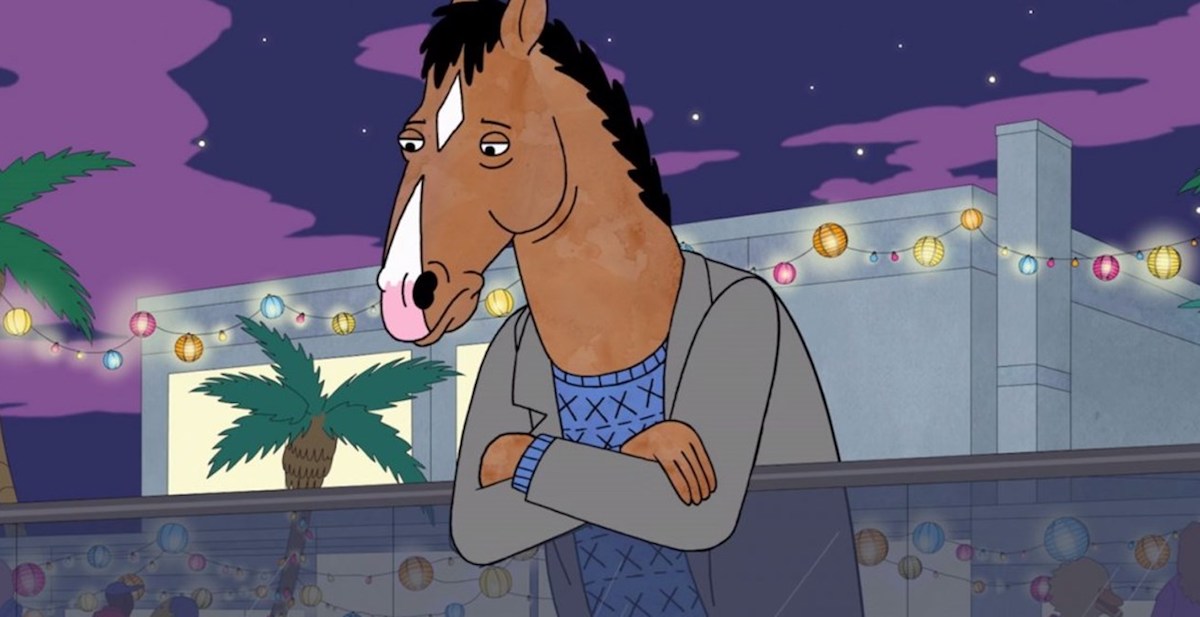
I’ve had this gnawing certainty that Bojack Horseman is a quintessential artistic representation of our era since I saw it for the first time two years ago. However, I’ve struggled to articulate my reasons for that conviction. I realized today as I finished season four that I’ve been waiting throughout that time to see how the story unfolds, suspending my attempts at understanding until I could factor in the end—the writers’ ultimate telos.
The End.
But that presumes there is a telos, and it’s the same dilemma the characters are facing: the metaphysical crisis of modernity. We can’t stop thinking about the ending because we want to know how it all works out, how all of the storylines and subplots come together to a final ending that is not only a resolution to all the tensions and conflicts the characters face, but one that reveals the ultimate meaning of their lives and our own—the purpose that justifies suffering. This craving to create order from chaos is ancient. We create stories because stories create us, helping us to navigate our own lives and inchoate feelings.
But BoJack Horseman isn’t a single story – or a book, or a film. Its episodic format is necessary to articulate its existentialist themes, an effect reinforced by its status as a web, rather than television, series. Since viewers tend to binge-watch web series in a manner television audiences could not, long stretches of time within Hollywood are compressed into much smaller periods of time in the viewer’s reality.
While the action peaks at times, the storylines often deny viewers satisfying resolutions, and upon reaching the end of a season they’re left with an uneasiness and shadow of ennui: what if even more time passes, and more things happen to the characters, but nothing ever changes or is resolved? What if the happy ending, or any ending, isn’t coming and never was? That everything from the most minor, irritating banalities to the moments of agonizing suffering will most certainly continue but are unlikely or even impossible to be justified? That there is no plan or purpose and that the real truth is that your life will boil down to circumstances beyond your control and how you react to them?
And what’s more terrifying than the idea of utter failure is the idea that it could be your fault. So long as you’re living by someone else’s plan, you can place the blame for all your unhappiness on them; but freedom extinguishes any attempt at plausible deniability. That’s why people fear it more than anything else – because maybe, just maybe, all those whispering voices inside your head are right: maybe you are insignificant, or not good enough, or forgettable. Maybe you won’t make it through the next hoop, despite all the ones you’ve made before. Maybe it was a fluke, maybe you are a phony, maybe the day will finally come that everyone will recognize you for the weak, stupid, cowardly imposter that you are. And you’ll keep running in place under the command of the Red Queen until you die.
Bleak and Beautiful
That the main character is an actor and the show is set in a fictionalized version of Hollywood are also significant elements to consider. The show’s writers and producers are engaging in staggering heights of meta-mythology. Camille Paglia asserts in Sexual Personae that modern Westerners use pop culture to manifest our suppressed pagan idols, creating within it a pantheon through which we can construct a shared mythology. Bojack’s personal grief is largely driven by the tension he feels between his persona (his status as a celebrity, as well as the role he played on Horsin’ Around) and the bleak and often tragic realities of his real life.
Paglia was inspired to write Sexual Personae by Ingmar Bergman’s Persona, a cinematic examination of the tension faced by individuals reflecting on their dual-, and what can at times feel conflicting, natures: who they are alone and who they are with others; as well as the stark inescapability of Being. Not unlike Bojack, Persona’s protagonist Elisabet is a famous actress who has chosen to “check out” on her life. Where Bojack turned to bourbon, however, Elisabet is hospitalized with a self-induced catatonia. When it’s discovered that the source of Elisabet’s stillness and silence is her own willpower, a matriarchal nurse addresses her with a gentle frankness:
I understand, all right. The hopeless dream of being – not seeming, but being. At every waking moment, alert. The gulf between what you are with others and what you are alone. The vertigo and the constant hunger to be exposed, to be seen through, perhaps even wiped out. Every inflection and every gesture a lie, every smile a grimace. Suicide? No, too vulgar. But you can refuse to move, refuse to talk, so that you don’t have to lie. You can shut yourself in. Then you needn’t play any parts or make wrong gestures. Or so you thought. But reality is diabolical. Your hiding place isn’t watertight. Life trickles in from the outside, and you’re forced to react. No one asks if it is true or false, if you’re genuine or just a sham. Such things matter only in the theatre, and hardly there either. I understand why you don’t speak, why you don’t move, why you’ve created a part for yourself out of apathy. I understand. I admire. You should go on with this part until it is played out, until it loses interest for you. Then you can leave it, just as you’ve left your other parts one by one.
When we lose our myths, we’re left to our own devices, and there is a sincere beauty in being able to create our own stories. But that’s not any guarantee that we’ll be good at it. And most of the time, we’re not. Bojack Horseman is the dream-turned-nightmare of postmodern apotheosis; the anguish of looking for gods and heroes and finding only ourselves.
This column originally appeared at the Foundation for Economic Education, and is reprinted by permission.