As Puerto Rico lies devastated by Hurricane Maria, viewers in the U.S. are unusually empathetic. This hurricane season gave birth to two major storms that made landfall in the continental United States. Hurricane Harvey devastated parts of Texas, and a few days later Irma did likewise to Florida. The loss of life and devastation caused by these storms was sobering. And there are more storms threatening out in the Atlantic. These were the first major hurricanes to hit the U.S. since the record setting year of 2005 which produced Katrina, Emily, Rita, and Wilma.
Predictably, some began citing the storms of 2017 as conclusive evidence of anthropogenic climate change. We are reminded constantly that 97 percent of environmental scientists agree that climate change is real. But 97 percent of scientists do not believe that climate change originating from human activity requires drastic government intervention. Simplistic conclusions about cause and effect for enormously complex systems such as the atmosphere often turn out to be in error as new research brings new understanding.
Sentimentalists cite Americans’ support for hurricane victims as proof of innate human goodness and that “we’re at our best when we all pull together.” The latter phrase is sometimes used as justification to advance collectivism in other realms.
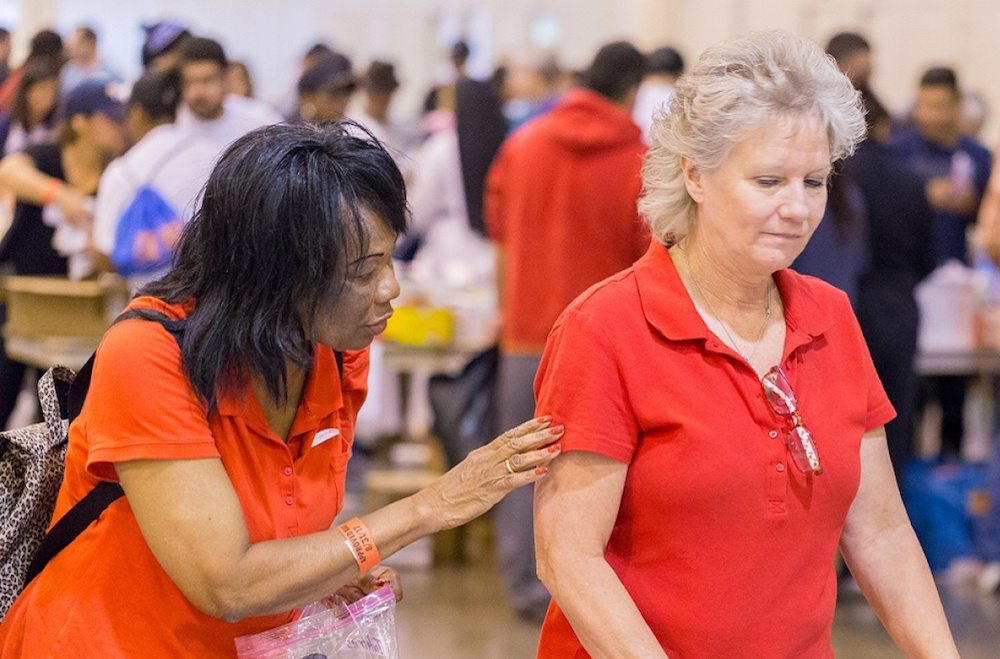
What is much more obvious about the reaction to these hurricanes is the immediate outpouring of relief that followed each. This uncoerced charity, which is as predictable as the sunrise, provides conclusive evidence of human solidarity.
Whenever disaster strikes, people – individually and in groups – voluntarily mount drives to alleviate the victims’ suffering. One only needs to “Google” Harvey or Irma hurricane relief to find countless stories of goods and money donated by ordinary Americans, companies, and celebrities. The Albuquerque Journal reported in late August that blood donations rose 35 percent above normal levels, specifically because of the hurricane in the neighboring state. With each catastrophe, organizations ranging from churches and schools, to service organizations and emergency relief agencies spring into action. After every natural disaster, people of goodwill spontaneously weave a beautiful and inspiring quilt of human solidarity.
The relief efforts we witnessed in Houston and Naples are not legally required. Rather, they are the result of a law of charity and solidarity that is written on the human heart.
This spontaneous response we witness would lose its essence if it becomes a requirement of state law or regulation. Virtue cannot be coerced. Natural disasters are an opportunity for each of us to make individual moral choices. The collective effort they inspire is uncoordinated, not planned. That it is free and spontaneous is what makes its an expression of human solidarity.
When the nanny state attempts to solve all our nation’s problems and challenges from cradle to grave, we lose these opportunities to exercise individual moral decision making. As the state’s role grows ever larger, intruding more deeply into our lives, the individual citizen’s role is diminished. We feel relieved of our duty to respond to human needs, and our sense of solidarity unravels.
As we lose opportunities to practice individual moral decision making, we lose these good habits. Over time this leads to a coarsening of society, both through our inaction and the conflict instigated by politicizing every aspect of society. The state, of course, has an essential role in a free society – and a leading role in disaster relief. But the state can be at its best only when the culture rests on a bedrock of virtue and solidarity.
The default position of a free people in a free society should never be to look first to the federal government for solutions. Whenever we conclude that a given problem in society is too large to solve using the principle of subsidiarity, we diminish the importance of our individual duty and diminish our sense of human solidarity. In turn, we run the risk of eroding the importance of individual character and virtue. As virtue declines in importance, we put less emphasis on transmitting the virtues to our children in the home and in our schools. Our culture and our country are thereby diminished.
No law of the state can prevent the erosion of our moral capital. The contours of that law exist only in the human heart. It’s being left free to choose – and choosing to act – that makes all the difference.
This column originally appeared at The Acton Institute, and is reprinted by permission.