During my semester abroad at Oxford University this past spring, I decided to try out as a violinist for the Oxford University Music Society (OUMS).
My fellow study abroad students and I always felt like imposters. What were we doing here with the U.K.’s best and brightest? Not to mention those with royal bloodlines. Every time I swiped my “Bod Card,” and the door of the Bodleian (the biggest library in the world) swung open I scurried past the grumpy librarians feeling like a thief.
As a violin performance major, I knew how to play, but I wasn’t at Oxford to study music. The audition found me questioning what I was hoping to accomplish. Not only did I feel out of my element at Oxford, but my life at home—or what I had been conceiving of my life—had begun to unravel. Yes, a boy, it’s always a boy, isn’t it?
I had to bike (or “cycle” as the Brits call it) to the audition at the Music Faculty building. The only way I could tote my violin there was to secure its case to the bike’s basket, wrapping it round with bungee cords as many times as possible. “Please dear God, don’t let my violin fall out,” I prayed as I headed off.
Miraculously, both my violin and I survived weaving through black cabs and around double decker buses.
After I got my bike to stand up properly and locked to the rack, I was met with a locked door.
As I waited outside the building in the whipping breeze I began to grow frantic. “Hello? Let me in!” I pleaded, as I knocked harder and harder.
A cheery face with red cheeks and bright eyes finally appeared to the side at the window, saw my plight, and let me in. He turned out to be a Brit named Eric. He led into a lounge area where an auditioning flautist was warming up. No sooner did I get my violin out and fumble through a passage of octaves and tenths, than I was called in.
I entered the audition room and faced a panel of conductors and orchestra fixers who were all around my age. I played my piece well and even nailed a passage with which I had previously struggled.
A bit of confidence began to creep in despite my intimidating Oxford University peers.
Then, pulled up some sheet music on a computer, and a conductor gave me a section from Mahler’s Symphony No. 2. “Er… Here you go. Start… There.” He pointed at some indeterminate point on the screen.
I stared at the electronic page trying to remain calm. I’m not a gifted-sight reader. Needless to say the sight-reading did not go well; in fact, my attempt at playing the section can only be described as a major Mahler massacre. Until the final passage I did not even realize that the key signature had flats.
When I finished the reading, I felt completely defeated. I could not get the rehearsal hall door to the lounge open fast enough. My inner critic screamed, “Run! You’ve made a fool of yourself—again.” Someone in authority at Oxford was finally going to say what I had long feared hearing. “Go back to Mississippi. You don’t belong here.”
I was hurriedly gathering up my things in the lounge, when the audition room door flew open again and a well-dressed young man bounded into the room, introduced himself, and said, “My colleague John has a concert on the same day as I do. He’s already sent you an email, but I want you to play in my orchestra as the principal second. Say ‘yes’ to me, not John.” I shook his hand, dumbfounded.
My bike wheels sang with his words the whole ride home. Oxford, with her dreaming spires and long music tradition, was saying to me, “You belong.”
When I got back to my room, I checked my email to find requests pouring in from the Oxford University Orchestra, Oxford University Sinfonietta, Consortium Novum, and St. Peter’s Chamber Orchestra. I cried like a baby. The audition hadn’t gone to plan, far from it, but I was still wanted. I felt free of the prison I had made for myself of unrealistic expectations. Musicianship and the long hours required are about perfecting one’s technique, but I didn’t have to be perfect in order to be accepted by others. Perhaps I could even let myself off that perfectionist hook.
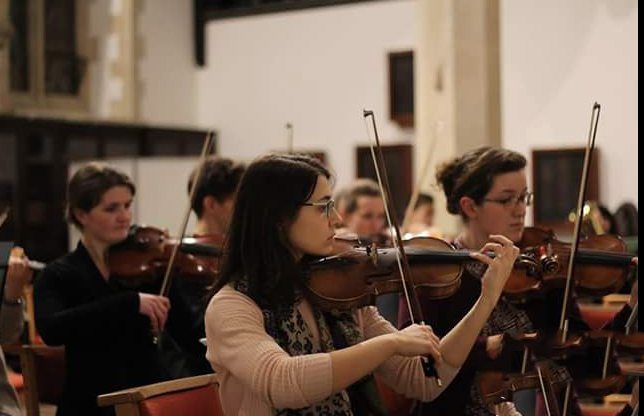
I lived out my newfound sense of freedom and acceptance in rehearsals that took place in all kinds of strange places. One was a college chapel where we kept the door wide open. Another was a church recreation hall where we had to wait for Zumba classes to finish. We worked up Stravinsky’s Rite of Spring there with Cardinal Newman’s portrait staring down on us.
Through my interactions with fellow musicians another door opened; it was like the door into the wardrobe in C.S. Lewis’s The Chronicles of Narnia: one that took me into magical kingdom of musicology. In one pub or another the students whom I met through music gathered for nerdy conversations about Stéphane Grappelli, Leonard Bernstein, Johannes Brahms, Luciano Berio, Amy Beach, and many others. For them, this was all normal. For me, it was blindingly beautiful.
But music is more than conversations in pubs or feeling exalted among talented peers. Above everything else, music is most powerful played.
This came home to me in full measure at a concert where I attended as a member of the audience. On a rainy night I heard I the Oxford University Philharmonia’s performance Mahler Symphony No. 2—the work I had so badly mangled at my audition.
By the time of the performance, I knew that my relationship with the young man at home was ending. So many hopes and dreams, so much planning and anticipation, were now all but gone. I was suffering.
I sat in the audience, in the stillness of the hall, and felt the music lift me from my earthly cares to new aspirations. Mahler composed this piece to answer the questions “What is life and what is death? Will we live on eternally? Is it all an empty dream or do our life and death have meaning?”
The final movement brought me to grateful tears as the choir sang, “You were not born in vain; have not lived in vain; suffered in vain.”
The huge choir soared above the orchestra, proclaiming, “Tremble no more! Prepare yourself to live!”
As the last note rang out from the orchestra the audience rose to its feet, and I felt newly prepared to live with as much intention as before, a greater self-confidence, and an unexpected inner peace. Oxford taught me to say, in concert with the theme of Mahler’s fourth movement, “Ah no! I did not let myself be turned away.”
(Now listen to the triumphant movement of Mahler’s 2nd)